Read our editorial on the significance of strikes here. Read our previous coverage of the attempted LIRR strike in September 2025 here and here.
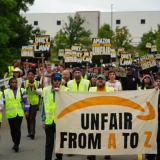
Over 3,500 Long Island Rail Road workers across five different unions went on strike today (05/16) after transit monopoly Metropolitan Transit Authority (MTA) refused worker demands around pay raises, healthcare contributions, and work rules.
The LIRR has around 300,000 daily passengers, making it the busiest commuter railroad in the country. The striking workers—roughly half of LIRR’s workforce, including signalmen, locomotive engineers, and machinists—have been without a contract for three years.
Over the past few months, LIRR workers who spoke with The Worker said they want to see their strike through and win their demands following union leadership shutting down an imminent strike last year. In late September 2025, workers voted 99% to authorize a strike that was timed to take place just before the Ryder Cup, an international golfing tournament in Long Island. Union leaders averted the strike by reaching out to the Trump administration to establish a Presidential Emergency Board (PEB), triggering the PEB’s mandated 120 day legal pause on strike action—a move typically reserved for the monopolists rather than the unions.
Now with the expiration of the PEB and MTA’s continued refusal to meet the workers’ demands, workers have succeeded in taking to the picket lines.
New York Governor and Democratic Mafia representative Kathy Hochul blamed the strike on “a small group of union leaders” and attempted to pit commuters against workers for fighting for wage increases to keep up with inflation. However, it is MTA that is beholden to a small group of people—the finance capitalists holding over $50 billion of MTA’s debt—underscoring both the fare hikes for commuters and wage and benefit cuts for workers.
Monopoly media reports that during negotiations MTA attempted to eliminate work rules that offered higher pay for extra work, which added up to an average of 15% of an engineer’s pay in 2024—meaning MTA was effectively pushing for a large pay cut while denying the workers’ demands for raises to offset real wage decline.
The workers have not seen a pay raise since 2022. A worker on the picket lines told The Worker that MTA has justified fare hikes by citing wage increases for 4 years, but challenged that rhetoric: “Wage increases for who? We haven’t seen anything!”
The impact to transit service will be magnified should the strike extend past the weekend, as the LIRR moves hundreds of thousands of commuters into New York City for work. The state comptroller’s office estimates the strike will cost the metro area $61 million a day according to a New York state press release, hand-wringing that the strike would be too powerful to offset with scab shuttle services and redirection to other means of transportation.
The last time LIRR workers went on strike was in 1994, when workers struck for two days, over the weekend. Then, union leaders capitulated and accepted a pay raise nearly half of what they were initially demanding.
The strike has implications for ongoing contract negotiations between MTA and the Transport Workers Union (TWU) 100, the New York City local representing subway and bus operators and other transit workers. TWU 100’s contract also expired on May 16, and both sides are waiting to see the outcome of the LIRR strike to influence their negotiating stances, a worker familiar with the matter told The Worker.
Image: Long Island Rail Road workers organized by the Brotherhood of Locomotive Engineers and Trainmen on strike. Credit: Brian Romero.
The Worker is an entirely volunteer-run revolutionary newspaper free from and radically antagonistic to corporate influence. We rely on the support of our readers to sustain our editorial line in service of the working class and the reconstitution of its party, the Communist Party. Make a one-time or recurring donation to our newspaper today:
Make a one-time donation
Make a monthly donation
Make a yearly donation
Choose an amount
Or enter a custom amount
Your contribution is appreciated.
Your contribution is appreciated.
Your contribution is appreciated.