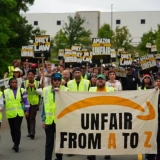
The Southeastern Pennsylvania Transportation Authority (SEPTA), Philadelphia’s public transit system, enacted major cuts to its services on August 24, affecting its roughly 800,000 daily riders. 20% of services have been cut across the board, including the elimination or reduced service of over 100 bus, subway, and train lines. A fare hike set to go into effect on September 1—averaging 20% across SEPTA services—has been paused by a court order after a lawsuit was filed against the transit authority.
On January 1, 2026, SEPTA plans on cutting services by an additional 25%, including ending all service after 9pm. The cuts follow the Pennsylvania state legislature’s failure to pass a budget that addresses SEPTA’S $213 million deficit.
The budget failure and subsequent cuts add up to attacks on poor and working people that also extend to SEPTA workers. Though layoffs have not been planned yet, a hiring freeze has been put in place, with a SEPTA spokesperson saying in reference to potential layoffs, “there are no options we can take off the table at this time.” Instead of putting up a fight, Transport Workers Union Local 234 President Brian Pollitt—the head of SEPTA’s largest union—said he contacted the police to increase their presence on public transportation in expectation of angry passengers, escalating the crisis and stoking contradictions among workers.
SEPTA data from 2022 shows that 50% of SEPTA riders earn $34,000 or less a year. With the January 1 curfew, evening and night workers will be left without public transportation entirely. While the cuts are first and foremost an attack on the lowest strata of workers who rely on public transit, it also lowers all the people’s rights and makes job competition worse, especially if SEPTA moves forward with mass layoffs.
Rideshare monopolies have already swooped in to corner the market generated by the cuts and profit off the people’s misery. With the direct backing of the Democratic mafia—which is also linked to SEPTA leadership—Uber has created a pilot program offering free rides to the elderly, a step toward privatization while public mass transit is whittled away. Meanwhile, workers will be forced to settle for lower paying jobs as they are less mobile while being fleeced by rideshare monopolies.
Economic and Political Crises Sharpen
The Pennsylvania state legislature, which has a Democrat-majority House and a Republican-controlled Senate, has remained at an impasse over the issue, which both sides seek to take advantage of for political gain. The Republican mafia aimed to use the Public Transportation Trust Fund, which receives money from certain taxes and is used for mass transit projects and upkeep, to keep SEPTA running in the short-term and fund rural roads and bridges—where the Republican’s voter base is. The Democratic mafia, along with SEPTA management—which is mostly comprised of Democrats—opposed this, arguing that the money is already earmarked for needed repairs and improvements. They instead proposed that mass transit be funded with a larger share of the sales tax. While the two mafias squabble over how to go about making cuts to the people’s rights, the interests of the billionaires remain intact.
Austerity measures are a symptom of the ongoing imperialist economic crisis, with monopolists forcing working people to pay for their crisis. Such measures—like the present failure of the state to fund SEPTA—funnel workers’ wages to monopolies and their repressive forces to protect their class dictatorship and away from programs that workers benefit from. Last year’s budget for the state gave monopolies over $1 billion dollars in direct subsidies, tax credits, and other handouts, while Governor Shapiro’s latest budget proposal increases the Pennsylvania State Police budget by $111 million, a 6.5% increase from the year before.
These trends follow federal gutting of already-meager social programs as well as ramping up spending on the armed forces and militarization of the police, increasing terror against the people and placing the burden of the crisis on the workers’ backs.
Transit Cuts Spread Across the Country
Philadelphia is not alone in its transit crisis. Chicago may face cuts to the majority of its public transit and lay off thousands of transit workers, while in New York City, activists with the Fare Ain’t Fair Coalition have successfully delayed a planned fare hike as they continue to push to end the hike altogether and expand subsidized access.
It is no surprise then that in both Philadelphia and New York City, angry residents are demanding the rich pay for transit, as it is a crisis of their own making. One resident in Philadelphia told The Worker, “Rent’s up, groceries’ up, utilities’ up, gas is up, cost of living’s up—everything’s up except your paycheck.”
In Philadelphia, bus stops are swarmed with people waiting 30 minutes or more for a bus to come that, when it does, sometimes drives right past because it is already full. Traffic times have doubled and many people’s bus routes to their jobs have been canceled completely. Workers are angry—angry about how little they are paid at their jobs, how they may have to pay even more for worse services while their bills keep racking up.
Photo credit: The Worker
The Worker is an entirely volunteer-run revolutionary newspaper free from and radically antagonistic to corporate influence. We rely on the support of our readers to sustain our editorial line in service of the working class and the reconstitution of its party, the Communist Party. Make a one-time or recurring donation to our newspaper today:
Make a one-time donation
Make a monthly donation
Make a yearly donation
Choose an amount
Or enter a custom amount
Your contribution is appreciated.
Your contribution is appreciated.
Your contribution is appreciated.